The dealership CRM demo felt like a different language. The vendor talked about desking a deal, penciling a payment, working an equity mining list, and routing internet leads through a BDC. I had spent a decade buying B2B sales software, and I understood maybe half of it. Then the dealer principal asked one question that made the whole category click: “Can it tell me which manager let a lead sit for two days?”
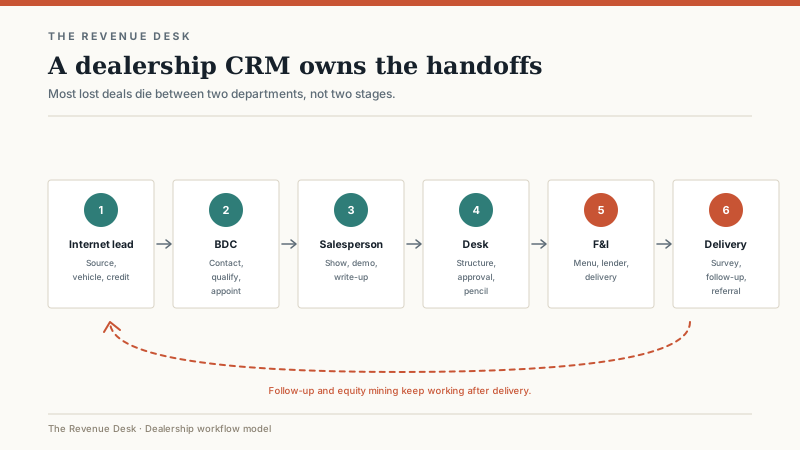
That is the job. A dealership CRM is not a general CRM with a different logo. It is a system built around the economics of a car deal: the lead source, the appointment, the trade, the finance office, the lender, and the follow-up that starts before the customer leaves the lot. Elead is one of the better-known names in that category, and the spelling “Eleads CRM” is common enough that it is worth clarifying: the product is generally written Elead CRM, and it is a dealership system, not a general-purpose sales platform.
Why a general CRM struggles on a dealership floor
A general CRM is organized around an account and a person. A dealership is organized around a deal, a vehicle, and a household. The same customer may buy three cars over ten years, service them at the same store, and trade one in for another. The CRM has to connect the sales history, the service history, the equity position, and the marketing consent for that household without creating three duplicate records.
Then there is the lead flow. A dealership does not get most of its leads from a salesperson’s network. It gets them from manufacturer websites, third-party marketplaces, paid search, chat, phone calls, walk-ins, and service drive conversations. Each source has its own response clock, its own cost, and its own definition of a qualified lead. A general CRM can store those leads. It usually cannot route them, score them, and report on cost per sale without a build project.
What a dealership CRM does that a general CRM does not
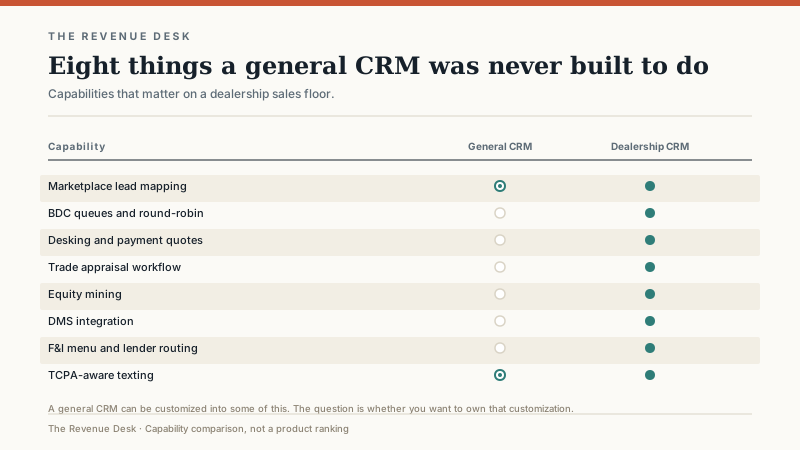
The differences are practical, not philosophical. Here are the eight that matter most in a franchise store.
Marketplace lead mapping. Leads from third-party sites arrive with source, vehicle, and sometimes credit information. The CRM has to capture the source accurately and route the lead to the right person or queue. A general CRM can accept a webhook. It rarely understands the lead types without custom work.
BDC queues and round-robin routing. A business development center works leads in priority order, with response-time targets and escalation rules. The CRM needs queues, assignment logic, and a manager view that shows who is behind. This is not a standard sales pipeline.
Desking and payment quotes. A desk manager structures the deal: selling price, trade allowance, down payment, term, rate, and monthly payment. The CRM needs to support that workflow and hand it to the finance office without re-keying. General CRMs are not built for payment quotes.
Trade appraisal workflow. The trade is often the most emotional and least standardized part of the deal. A dealership CRM captures the appraisal, the condition report, the payoff, and the equity position so the desk can make an offer without chasing three people.
Equity mining. The CRM can identify customers with positive equity, near the end of their loan, or coming off a lease, and turn that into a campaign. This is a revenue engine, not a report. General CRMs can approximate it with custom fields and automations, but the data usually lives in the DMS.
DMS integration. The dealership management system holds the deal, the inventory, the accounting, and the service history. The CRM has to talk to it. If the integration is weak, someone re-keys the deal, and the CRM’s data drifts from reality within a week.
F&I menu and lender routing. The finance and insurance office needs to present products, route the deal to lenders, and capture the final contract details. This is a specialized workflow with compliance requirements. A general CRM does not have it.
TCPA-aware texting and calling. Customer communication needs consent tracking, opt-out handling, and a record of what was sent. A dealership that texts a customer without consent is a lawsuit waiting to happen. The CRM should enforce the rules, not leave them to a salesperson’s judgment.
What Elead does well
Elead is built for the dealership workflow, which means the vocabulary in the product matches the vocabulary on the floor. The lead routing, BDC tools, desking, and equity mining are native rather than bolted on. The reporting is designed for a dealer principal who wants to see lead source, response time, appointment rate, show rate, close rate, and gross profit without exporting to a spreadsheet. The mobile app supports the walkaround and the lot, which matters more than most vendors admit.
The other strength is the integration story. A dealership CRM is only as good as its connection to the DMS and the marketplace leads. Elead’s ecosystem is built around those connections, and the vendor has been in the category long enough to have seen the edge cases. That is not a guarantee, but it is a better starting point than a general CRM with a custom integration project.
Where it strains
Dealership CRMs are expensive and opinionated. They are priced per user and sometimes per rooftop, with implementation and integration fees that can rival the first-year software cost. The contract is usually annual, and the vendor knows the switching cost is high. If you are a single-point independent used lot with three salespeople and a short deal cycle, the economics may not work. A simpler tool and a disciplined process may be enough.
The other strain is adoption. A dealership CRM has more screens than a general CRM because the work has more steps. If the BDC does not use the queues, if the salespeople do not log the walk-in, if the desk keeps a side spreadsheet, the system becomes a reporting layer for incomplete data. The software cannot fix a store where the manager does not enforce the process.
It is also a poor fit for a B2B company, a service business, or a company with a long consultative sale. The workflow is too specific. You would be paying for desking and F&I features you will never use.
What to test in a demo
Bring a real deal, not a hypothetical. Ask the vendor to desk it, generate a payment quote, route it to a lender, and show the final gross profit. Ask how a trade appraisal flows from the salesperson to the desk to the CRM. Ask how an internet lead from a third-party marketplace is attributed, and what happens when the same customer inquires on three vehicles in one day.
Test the after-hours experience. What happens when a lead arrives at 9:14 p.m. and the BDC is closed? Does the CRM create a task, send an auto-response, and escalate in the morning? Test the mobile app on a phone with a weak signal. Test the report a dealer principal will ask for on the first Monday of the month, and ask how long it takes to produce.
Then ask the contract questions: What is the implementation fee? What is included in the first year? What does the renewal look like? What happens if you add a rooftop? Can you export your customer and deal data in a usable format? Who owns the data if you leave? The answers matter more than the demo’s polish.
Implementation and adoption
The implementation should start with the lead flow, not the software configuration. Map every lead source, every handoff, and every person who touches a lead. Decide the response-time targets and the escalation rules before the vendor configures anything. Then clean the customer data before you import it. A dealership CRM with 40,000 duplicate customer records will produce 40,000 duplicate follow-up tasks.
Training should be role-specific. The BDC needs a different session than the sales floor, and the desk needs a different session than the F&I office. A single two-hour overview for everyone is a recipe for partial adoption. The manager should review the queue and the response-time report daily for the first 30 days. After that, weekly is enough.
The measure of success is not “everyone logged in.” It is whether the store can answer three questions without a meeting: Which leads are past their response target? Which salesperson has the highest appointment-to-show rate? Which lead source produced the most gross profit last month? If the CRM can answer those questions and the team trusts the answers, the implementation worked.
If you are still comparing categories, the best CRM software shortlist by sales motion explains where a vertical tool belongs. If you are trying to decide whether to customize a general CRM instead, read what a CRM can and cannot fix first. And if you are choosing a CRM for a non-dealership sales team, the decision framework for teams with a number to hit is a better starting point than a dealership product.
Elead is a serious tool for a serious workflow. It is not the cheapest way to store names and phone numbers. It is the right conversation when the store’s problem is lead response, handoffs, and gross profit, not contact storage.
