A six-person landscaping company I worked with ran its entire sales operation on a free CRM for almost two years. It worked. The owner could see the pipeline, the estimates went out on time, and nobody paid a subscription. Then the company added a second crew, hired a part-time office manager, and tried to give her access to the same pipeline. That was the day the free tier stopped being free.
The upgrade itself was not the problem. The problem was the work the free tier had been hiding: the owner was the administrator, the data lived in one person’s login, and the follow-up process depended on a weekly routine that nobody had written down. The paid plan cost less than the time it took to work around the free plan. It just took two years to notice.
That is the free CRM for small business pattern: the subscription is zero, but the workaround has a cost. The bill arrives in hours, not invoices.
What a free CRM actually gives you
Free CRMs are real products now. HubSpot’s free CRM is genuinely usable. Zoho, Bitrix24, Freshworks, and a handful of others offer free tiers that include contacts, deals, tasks, and a pipeline. For a team of one to three people, a free tier can carry you for a year or more.
The limits are predictable. Free tiers usually cap users, contacts, pipelines, automation, custom reporting, file storage, or support. Some cap all of them. The limits are published, but they change, and the marketing page is not a contract. If a limit matters to your business, get the current terms in writing before you import your customer list.
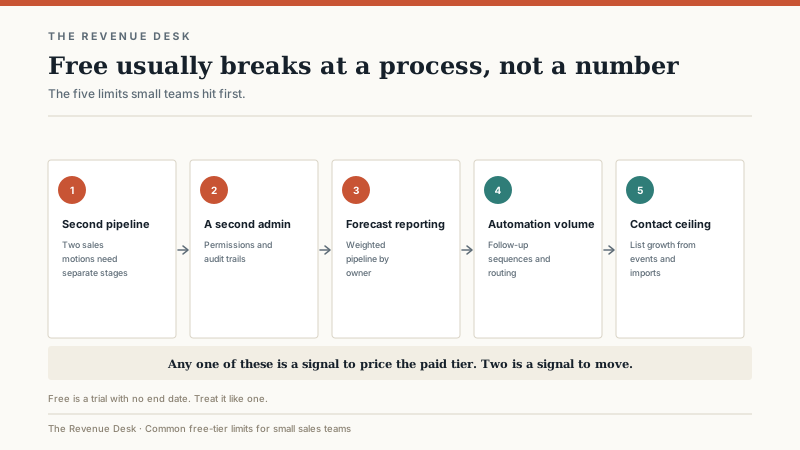
The five walls
The second pipeline. Most free tiers give you one pipeline. A company with new business, renewals, and a partner channel needs three. You can sometimes fake it with stages, but the reporting gets messy. The second pipeline is often the first honest signal that you have outgrown the free tier.
The second admin. Free tiers usually give every user the same access. That is fine for two founders who trust each other. It is not fine when you hire a contractor, a junior rep, or an office manager who should not see every deal. Permissions and audit trails are paid features for a reason.
Forecast reporting. A free pipeline view shows you what is open. It rarely shows you a weighted forecast by owner, stage, or source. The report your banker or your board asks for is usually the one that requires the paid tier.
Automation volume. Free tiers often include a small number of automated actions or a simple workflow. That is enough for a follow-up reminder. It is not enough for lead routing, territory assignment, and a multi-step nurture sequence. The automation limit is usually measured in runs, not features, so it appears quietly in month four.
The contact ceiling. Every free tier has a number. When you cross it, you either stop importing or upgrade. The number is often lower than it looks because marketing contacts, archived records, and duplicates all count. A company that imports a trade show list every quarter will hit the ceiling faster than a company that adds 20 customers a month.
The hidden cost of free
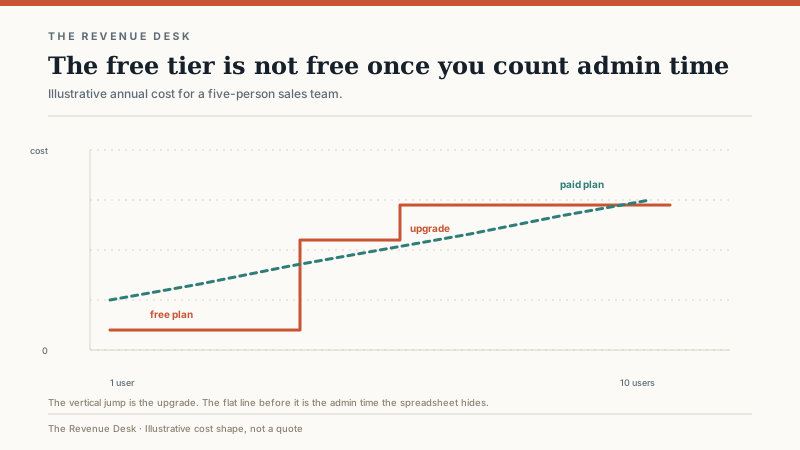
The subscription is zero. The administration is not. Someone has to set up the pipeline, import the contacts, build the reports, train the team, and clean the duplicates. In a small company, that someone is usually the owner or the most organized salesperson. Their time is not free, even if it does not appear on an invoice.
Free tiers also encourage workarounds. You use a spreadsheet for the forecast because the free report is too limited. You use a shared inbox for the second pipeline because the free tier only allows one. You use a calendar reminder for the follow-up because the automation limit is too low. Each workaround is small. Together they create a second system that nobody owns and nobody documents.
There is also a data risk. Free tiers can change their terms, limit exports, or disappear. A CRM that holds your customer history should have a clear export path. If you cannot download your contacts, deals, and activity history in a usable format, you do not own your data. You are renting it.
When free stops working
Free CRM for small business stops working when you hire the second person who needs access, when you add a second sales motion, when you need a report that combines deals with revenue, when you need permissions, when you need support, or when the contact ceiling forces you to delete records you might need later. Any one of those is a signal. Two of them is a decision.
It also stops working when the owner becomes the bottleneck. A free CRM that only the owner can administer is a single point of failure. If the owner is on vacation, the pipeline stops. If the owner leaves, the customer history leaves with them. A paid tier with role-based access is not just a feature. It is business continuity.
The cost math
Small business CRMs typically run from about $15 to $50 per user per month on an annual plan. For five users, that is roughly $900 to $3,000 per year. Compare that with the cost of the workaround. If the owner spends five hours a week on administration that a paid tier would reduce to two, the difference is three hours a week. At a fully loaded rate of $40 an hour, that is $6,240 a year. The subscription is cheaper than the workaround.
That math is not an argument for the most expensive plan. It is an argument for counting the hours. A free tier that takes two hours a week and does everything you need is a good deal. A free tier that takes eight hours a week and forces three workarounds is not free. It is a part-time job with a zero-dollar invoice.
Free options worth considering
HubSpot’s free CRM is the strongest general-purpose option for a small team that wants a real pipeline, email integration, and forms without a credit card. The free tier is good enough to learn what you need, and the upgrade path is clear. The trade-off is that the paid tiers can get expensive as contacts and hubs are added, so model the next step before you commit.
Zoho CRM’s free edition is a reasonable option for a very small team that wants a traditional CRM and is comfortable with a less polished interface. Bitrix24’s free tier includes a surprising amount of functionality, including collaboration tools, but the interface can feel sprawling. Freshworks and other vendors have free tiers or trials that change frequently; check the current terms rather than relying on an old review.
A spreadsheet is not a CRM, but it is not nothing. For a one-person business with a short sales cycle and no repeat business, a well-structured spreadsheet plus a calendar reminder may be the right answer. The mistake is using a spreadsheet for a process that has outgrown it, then blaming the spreadsheet.
How to start free without regret
Define the three reports you need before you import anything. Pick a naming convention for companies and contacts and write it down. Import only the accounts you are actively working, not your entire email history. Set a rule for who can create a contact and who can merge duplicates. Export your data once a month and keep the file somewhere you control. Assign one person to own the system, even if it is a part-time role. Review the plan every six months and ask whether the free tier still fits the process.
Do not customize the free tier heavily. The customization will not survive the upgrade, and the time you spend building it is time you could spend selling. Use the free tier to learn the workflow, not to build a permanent system.
When to skip free entirely
Skip free if you are in a regulated industry that requires audit trails, consent tracking, or data retention controls. Skip it if you have more than five users, multiple pipelines, or a sales process that needs permissions. Skip it if you need support with a response time, not a community forum. Skip it if your customer data is the core asset of the business and you cannot afford to lose access to it.
If you are comparing free tiers, read the HubSpot CRM review for the most common starting point. If you are ready to pay, the decision framework for teams with a number to hit will help you avoid overbuying. And if you are still defining the process, read what customer relationship management can and cannot fix before you spend a dollar on software.
Free is a good place to start. It is a bad place to stay. The goal is not to avoid the subscription forever. The goal is to know when the subscription costs less than the workaround. For most small businesses, that day arrives earlier than they expect.
