A VP of Sales once told me she had 43 days to fix forecast accuracy. She had already shortlisted three CRMs and wanted a recommendation by Friday. I asked what she would do if all three were fine. Without hesitating, she said she would pick the one her reps would actually use. That was the right answer, and it was not on the shortlist.
The best CRM is not the one with the most features, the highest review score, or the biggest logo on the conference banner. It is the one your team uses after the consultants leave, the one your admin can maintain without a second job, and the one your business can still afford in year three. Everything else is a demo.
Four rules that matter more than the feature list
Adoption beats capability. A CRM with a 60 percent adoption rate and average features will outperform a feature-rich CRM that reps avoid. The data in the system is the system. If the data is incomplete, the forecast is fiction, the reports are fiction, and the AI is fiction with better typography. Ask every vendor how they measure adoption and what happens in the first 30 days after launch. The answer tells you more than the roadmap.
Fit the sales motion you have, not the one in the deck. A high-volume inside sales team needs speed and sequences. A consultative mid-market team needs stage discipline and reporting. A field team needs mobile and territory. An enterprise team needs customization and governance. The same platform can be excellent in one motion and mediocre in another. If the vendor’s reference customer looks nothing like you, ask why.
Count the admin hours. The license is the visible cost. The admin is the real one. Someone has to own fields, permissions, reports, integrations, and the steady stream of requests that starts the week after launch. A system that requires a full-time admin is not disqualified, but the salary belongs in the business case. A system that requires no admin usually means someone is doing the work in spreadsheets.
A CRM cannot fix a comp plan or a weak manager. It can make the consequences visible. If the comp plan pays for new logos and the business needs renewals, the CRM will show a pipeline full of new logos. If the manager does not coach, the CRM will show activity without progress. Software is an accelerant. It accelerates whatever is already there.
Build the scorecard before the shortlist
Get the same five people in a room: the sales leader, the sales operations lead, the admin, a top-performing rep, and someone from finance. Agree on the criteria and the weights before you see a demo. The weights should reflect the business, not the vendor’s strengths.
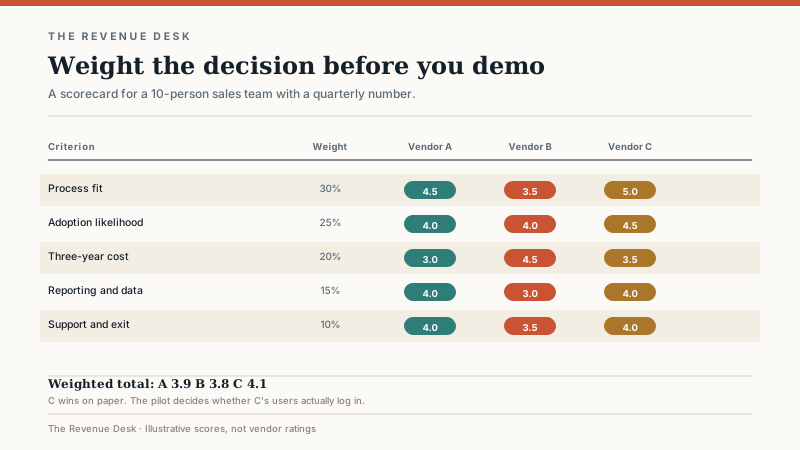
For a 10-person sales team with a quarterly number, I start with process fit at 30 percent, adoption likelihood at 25 percent, three-year total cost at 20 percent, reporting and data at 15 percent, and support and exit at 10 percent. A larger enterprise team might weight reporting and governance higher. A small team might weight cost and time to productivity higher. The exact numbers matter less than the agreement on what matters.
Score each vendor from 1 to 5 on each criterion. Multiply by the weight. Add the totals. Then look at the spread, not just the winner. If two vendors are within 0.3 points, the scorecard has done its job by narrowing the field. The pilot will decide the rest. If one vendor scores below 3 on adoption, disqualify it regardless of the total. A tool nobody uses is not a bargain at any price.
Shortlist three, not ten
Three is enough to create competition and few enough to evaluate seriously. Ten vendors means ten demos, ten sales cycles, and a team that is exhausted before the real work starts. Use the shortlist to cover three archetypes: the structured platform, the fast-to-adopt challenger, and the value option. If the value option cannot survive the first round, drop it and move on.
Give every vendor the same demo script. Use your real stages, your real reports, and your real edge cases. Ask each one to show a deal with a missing close date, a duplicate contact, and a rep working from a phone. A vendor that can handle the ugly parts in a sandbox is more trustworthy than one that can only handle the polished demo.
If you want product-specific context, the best CRM software shortlist by sales motion covers the categories. This article is about the decision process, not the vendor menu.
The four-week pilot
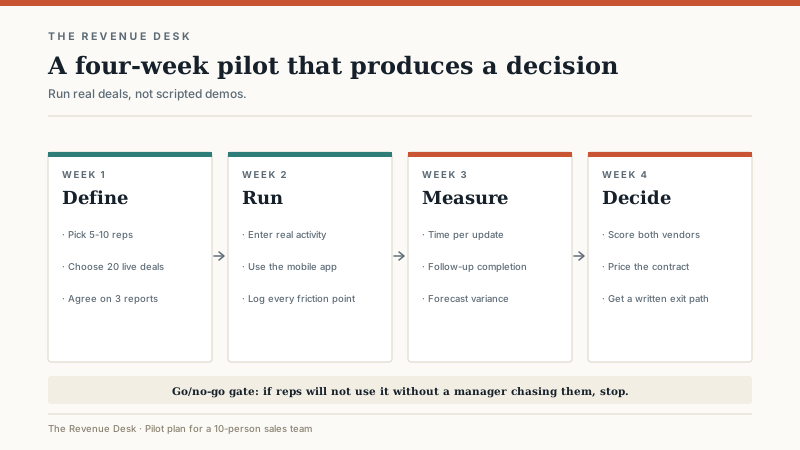
A pilot is not a free trial. It has a hypothesis, a scorecard, and a deadline. Run two vendors in parallel with the same five to ten reps and the same 20 live deals. Do not use fake data. The point is to see how the system behaves when a real customer is waiting.
Week 1: define. Pick the reps, the deals, and the three reports. Agree on what “success” looks like in numbers. Set the baseline: how long does a rep take to update a deal today, how many follow-ups are missed, how accurate is the forecast?
Week 2: run. Use the system for real work. Log the activity, move the stages, use the mobile app, and write down every friction point. The friction log is more valuable than the vendor’s satisfaction survey.
Week 3: measure. Compare the pilot metrics with the baseline. Time per update, follow-up completion, forecast variance, admin tickets, and rep satisfaction. If the reps are slower and less accurate, the demo was better than the product.
Week 4: decide. Score both vendors, price the contract, and ask for a written exit path. If the pilot did not produce a clear winner, do not sign. Run a second pilot or go back to the shortlist. A delayed decision is cheaper than a bad one.
The pilot metrics that matter
Time per update. How long does it take a rep to log a call, update a stage, and set the next task? If the answer is more than a minute or two, the system is competing with selling. A CRM that saves the manager time but costs the rep time will lose.
Follow-up completion. Of the tasks created in the pilot, how many were completed on time? This is the leading indicator of whether the reminder engine works. A system with great reporting and poor follow-up is a scoreboard for a game nobody is playing.
Forecast variance. Compare the forecast at the start of the pilot with the closed-won result at the end. A small sample is noisy, but a large variance is a signal that the stages or the close dates are not honest.
Admin tickets. Count the requests the pilot generated. If the admin is already underwater in week two, the system will not scale. If there are no tickets, the reps may not be using it.
Rep satisfaction. Ask a simple question: would you want to keep using this after the pilot? The answer is not the whole decision, but a “no” from the people who have to use it is a red flag you should not ignore.
Negotiation: the terms that matter
The first-year discount is the least important number in the contract. The renewal is the number that matters. Ask for a cap on renewal uplift, ideally 3 to 5 percent per year. Ask for a seat ramp that matches your hiring plan. Ask what happens if you need fewer seats at renewal. Ask whether the discount applies to add-ons or only to the base license.
Get the implementation scope in writing. “Configure stages and two dashboards” is testable. “Implement sales process” is not. Include acceptance criteria, the number of revision rounds, and the hourly rate for work outside the scope. Ask who owns the data, how you export it, and whether there is a fee for export. Ask for a termination-for-cause clause and a clear auto-renewal notice period.
Do not sign a multi-year deal before the pilot. Do not accept a verbal promise about a future feature. Do not let the vendor bundle a product you do not need to make the discount look better. The best negotiation is the one where you know your walk-away number before you sit down.
Implementation: the first 90 days
Name one owner. Define four to six stages. Clean the data before you import it. Configure the ten fields the team will use, not the hundred the vendor recommends. Train in short sessions tied to real work. Review adoption weekly for the first month, then monthly. Do not customize anything in the first 30 days unless it is blocking a core process.
The most common implementation mistake is treating launch day as the finish line. It is the starting line. The first 90 days are when the process either becomes a habit or becomes a workaround. The manager’s job is to look at the same five numbers every week and ask about the outliers. The CRM supplies the numbers. The manager supplies the consequence.
What “best” looks like at different sizes
One to five users. Best means simple, cheap, and fast to set up. A free tier or a low-cost plan with a clean pipeline and email sync is enough. Do not buy enterprise features you will not use.
Five to twenty-five users. Best means a balance of adoption, reporting, and cost. You need permissions, a few automations, and a forecast that finance trusts. A mid-market CRM or a flexible platform with a strong admin can work.
Twenty-five to one hundred users. Best means governance. You need roles, territories, multiple pipelines, integrations, and a dedicated admin. The implementation partner matters as much as the software.
One hundred or more users. Best means platform strategy. You are buying an ecosystem, not an app. The decision involves IT, security, procurement, and a multi-year roadmap. The pilot is a program, not a project.
What “best” is not
It is not the tool with the longest feature list. It is not the one with the highest review score. It is not the one your investor uses, the one your competitor announced, or the one with the best commercial during the conference. It is not the cheapest option if the cheap option costs a part-time admin. It is not the most expensive option if the expensive option goes unused.
The best CRM is a decision you can defend with numbers, a pilot, and a plan for the first 90 days. If you can explain why you chose it, what you expect it to change, and how you will know if it worked, you have made a good decision. If the explanation is “it was the best one,” you have made a purchase, not a decision.
If you are still defining the process the CRM is supposed to support, start with what customer relationship management can and cannot fix. If you are comparing specific platforms, the Salesforce and HubSpot breakdowns cover the cost structures. And if you want the shortlist by sales motion, read the best CRM software guide. The right order is process, then scorecard, then pilot, then contract. The wrong order is demo, demo, demo, signature.
