Every few months, someone lands on this site after searching “NYSE CRM” and expects a product review. They saw the ticker in a stock app, a brokerage email, or a headline, and they want to know what it means for the software they are about to buy. The short answer: NYSE: CRM is the stock ticker for Salesforce Inc. It is not a CRM edition, a pricing tier, or a separate product. It is the public market’s name for the company that sells Salesforce CRM.
That distinction matters more than it sounds. A software buyer and a shareholder are asking different questions. The shareholder is asking whether the company will grow faster than expected. The buyer is asking whether the product will do the job at a price the business can defend. The ticker can inform the second question, but only at the edges.
What the ticker actually tells you
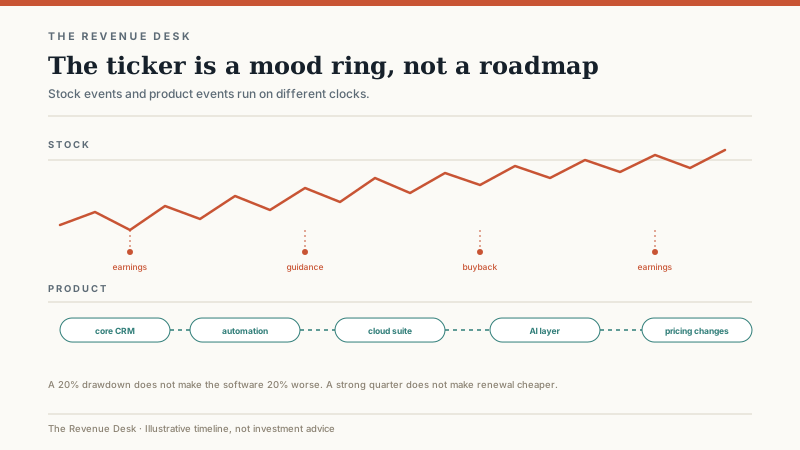
A stock price is a consensus guess about future cash flows, growth, margins, and risk. It moves when those guesses change. It does not move when a product team ships a good feature, unless that feature changes the financial story. It moves when guidance changes, when a large deal slips, when a competitor announces something the market thinks is existential, or when the Federal Reserve does something unrelated to CRM software.
Salesforce is a large, profitable public company with a long history of growing through acquisitions and platform expansion. The stock is widely followed, which means every earnings call is dissected by people who spend their entire job on it. You are not going to out-analyze them on a lunch break. But you can use the same public information to understand the vendor’s priorities, pricing pressure, and product direction.
Three things a buyer can learn from the public numbers
Where the company is investing. Earnings calls and investor materials usually highlight the segments and products management wants you to notice: Data Cloud, AI features, industry clouds, international growth, or margin expansion. Those priorities show up in packaging, sales incentives, and roadmap investment. If the company is pushing a platform bundle, expect the sales team to lead with the bundle.
How much pricing pressure exists. Public companies are judged on revenue growth and margin. When growth slows, the pressure to raise prices, reclassify seats, or bundle add-ons increases. That does not make the product worse, but it changes the renewal conversation. A buyer who understands the pressure can negotiate a renewal cap before the pressure arrives.
Whether the backlog is growing. Salesforce reports remaining performance obligation, which is essentially contracted revenue not yet recognized. A growing backlog can signal that customers are committing to longer contracts. A shrinking backlog can signal the opposite. Either way, it tells you something about how the vendor is managing its customer base, not whether the software is good.
What to ignore
Ignore the daily price move. Ignore the analyst price target, which is a guess with a deadline attached. Ignore the headline that says the stock is “down 8 percent after earnings” unless you also read why. A 20 percent drawdown does not make the software 20 percent worse. A strong quarter does not make your renewal cheaper. The product you are buying is the same product on both days.
Ignore the temptation to use the stock price as a proxy for vendor health. Salesforce is not going out of business next quarter. The risk with a vendor of this size is not disappearance. It is pricing, packaging, roadmap shifts, and the slow accumulation of add-ons that make the renewal more expensive than the original deal. Those risks are in the contract, not the chart.
Where the revenue comes from
Salesforce is not just Sales Cloud. It sells service, marketing, commerce, platform, data, integration, and professional services. The exact mix changes every quarter, but the broad shape is useful: the core sales and service clouds are the center of gravity, the platform and data products are the growth story, and professional services are a smaller but strategically important piece. A buyer who only evaluates Sales Cloud may miss the fact that the vendor’s roadmap is increasingly about the platform around it.
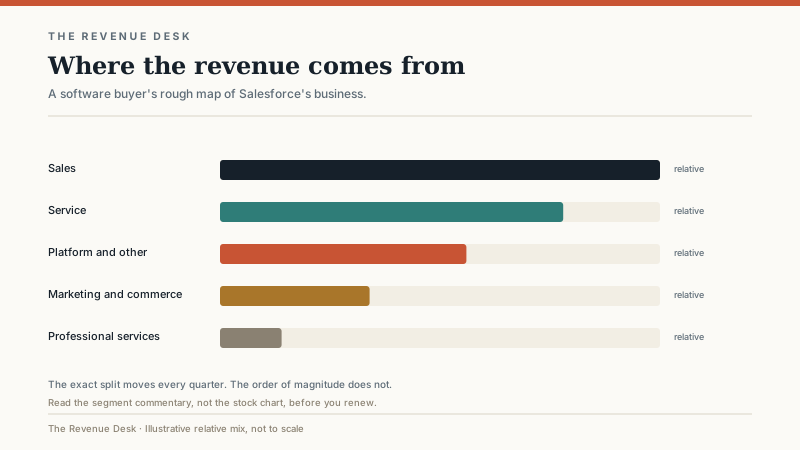
This matters at renewal. If the vendor is pushing a platform story, the renewal conversation will likely include products you did not originally buy. If the vendor is focused on margin, the discount you received in year one may not be available in year three. Neither outcome is sinister. It is how public software companies manage growth. The buyer’s job is to know which conversation is happening before the quote arrives.
How to read an earnings call as a buyer
You do not need to listen to the whole call. Read the prepared remarks and the Q&A transcript. Listen for four things: pricing, packaging, customer count, and the language around AI monetization. When management says a product is “seeing strong adoption,” ask whether that means paid seats or free trials. When management says customers are “consolidating on the platform,” ask whether that means more products per customer or more discount per renewal.
Keep a note of what the company promises and check it the next quarter. If management says a new product will be generally available in the second half, and it slips, that is useful information about roadmap reliability. If management says pricing will remain stable, and the next earnings call announces a packaging change, that is useful information about contract risk. You are not trading the stock. You are building a picture of how the vendor behaves.
What this means for your contract
Public-company pressure shows up in predictable places. Quarter-end discounting is real, but the discount often comes with a longer term or a higher renewal. Seat true-ups can be priced above the original blended rate. Add-on bundles can make the first year look cheaper while raising the three-year cost. A multi-year deal can protect you from price increases, or it can lock you into a product mix you do not need. The details are in the paper, not the press release.
Ask for a renewal cap. Ask for a seat ramp that matches your hiring plan. Ask what happens if you want to remove a product at renewal. Ask whether the discount is on the license, the add-ons, or both. Ask for the data export terms. These questions are boring, which is why they work. The sales team is prepared for questions about features. They are less prepared for questions about the exit.
What the ticker does not tell you
It does not tell you whether the product fits your sales process. It does not tell you whether the implementation partner will deliver. It does not tell you whether your reps will use the system after the training. It does not tell you whether the total cost of ownership is justified by the problem you are solving. Those are the questions that determine whether the purchase works, and none of them are in the stock chart.
If you are evaluating Salesforce as a product, start with the Salesforce CRM buyer’s walkthrough, which covers editions, add-ons, and the real bill. If you are inheriting an existing org, read the SFDC takeover guide. If you are still building a shortlist, the best CRM software comparison by sales motion is a better use of an afternoon than a stock chart.
One disclosure: this article is about software buying, not investing. It is not financial advice, and it is not a recommendation to buy, sell, or hold any security. If you want investment advice, talk to someone who does that for a living. If you want to buy CRM software, talk to your sales operations lead, your admin, and the people who will actually use the system. They have better information than the ticker.
NYSE: CRM is a useful label for a company. It is a poor label for a buying decision. Buy the product, not the ticker. The stock can tell you what the market expects from Salesforce. Only your team can tell you whether Salesforce expects the same thing from your sales process.
